Context Sensitivity: Leaping Forward in Gaming
These last couple of years have been a fantastic period of innovation for videogames. One of my favorite innovations in game design is the trend of simplifying overly complex actions into simplified context-sensitive controls. A general rule of game design is, "The less the player has to manage, the more fun the gaming experience will be." Context-sensitivity champions this concept and is leading a new era of gaming.
A great demonstration of the evolution of this gameplay mechanic can be found in the classic videogame standard of the jump button. Ever since the days of Donkey Kong, players have hopped their gaming avatars across digitized levels by pressing a button, but as industry grew so did the need for more buttons to manage more actions. Developers wished to give players more freedom and discovered that the one or two button controller configuration wasn't enough.
Sega in response to this growing issue creates a novel equation to solve this issue, more buttons equals more actions can be mapped to the controller. Thus the six button controller is born. Years later the formula devised by Sega has led to numerous console controller inventions, such as the Super Nintendo's addition of left or right shoulder buttons and Nintendo 64's analog stick. Standard console controllers today, excluding the Wii Remote, feature the configuration of; four face buttons, two analog sticks with corresponding buttons, four shoulder bumpers with varying degrees of sensitivity, and a pause button or console menu button.
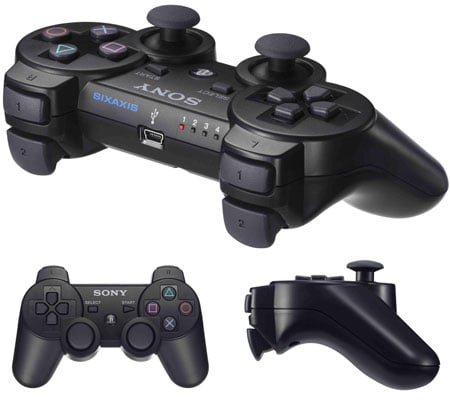
Even with the retail space afforded by such controllers, developers are facing the question once presented to them in the Nes days, "How do we fit complex game mechanics on such a limited control scheme." There has been numerous methods devised for such an issue and context-sensitive actions is one incredible byproduct.
Returning to the analogy of how jumping has changed over time by ways of context-sensitivity. The Legend of Zelda: A Link to the Past, I believe, was one of the first video games to feature automated jumping. The player loses the ability jump with a press of a button and instead merely needs to move beyond an edge for the character to leap forward. This isn't quite the same as modern day context-sensitivity because the player has zero input on the action, but it marks the beginning of reducing standard videogame avatar actions to an automated system.
The Legend of Zelda: Ocarina of Time with automated jumping.
Another forefather to context-sensitivity is a gameplay mechanic known as quick-time-events, or QTE for short. The first appearance of this mechanic was in the Dreamcast title Shenmue. A quick-time-event boils down to an in-game cinematic that requires player input to continue gameplay. If a player fails to input the correct commands then the game ends or an adverse condition occurs. The videogame Indigo Prophecy uses this system extensively and is the core mechanic which drives the title's narrative.
Context-sensitivity was born from these two gameplay innovations and is a staple of modern gaming. Gameplay once deemed too complex to be adequately mapped to the limited interfaces of console controllers, can now be relegated to single-button presses with interactive Hollywood-quality cinematics.

Assassin's Creed demonstrated the depth of context sensitivity
This long diatribe is intended as a precursor to videogame trailer released a few days ago, yes I spent this much text for a single video, but you'll understand my reasoning after witnessing the trailer.
Every action in the above trailer was performed with two button presses. Developed by studio EA Blackbox, creator's of SKATE, is their latest game a Sci-fi parkour title known as Mirror's Edge.
I believe we're entering into a Golden Age of gaming.
-Ciao gaming compatriots!
Labels: Context Sensitivity, EA, Electronic Arts, Indigo Prophecy, Mirror's Edge, QTE, Quick Time Events, Shenmue, SKATE
posted by Alex Wolken (Steam:FeivelGoesWest) @ 9:57 PM
1 Comments


1 Comments:
I must say that that game looks like the most amazing game I've ever seen. I agree with you, that if more games like this are soon to be released, then we have truly reached a new period of gaming; unlike anything ever experienced.
-FlyingHamHock
Post a Comment
Subscribe to Post Comments [Atom]
<< Home